Top surgery
Top surgery, also called chest masculinisation mastectomy, removes most of the breast tissue, treats excess skin if needed and reshapes the chest for a more masculine appearance. Dr Manon Belhoste performs this procedure in Marseille for French and international patients. Prices are still being negotiated with the relevant authorities and partner clinics.
The procedure
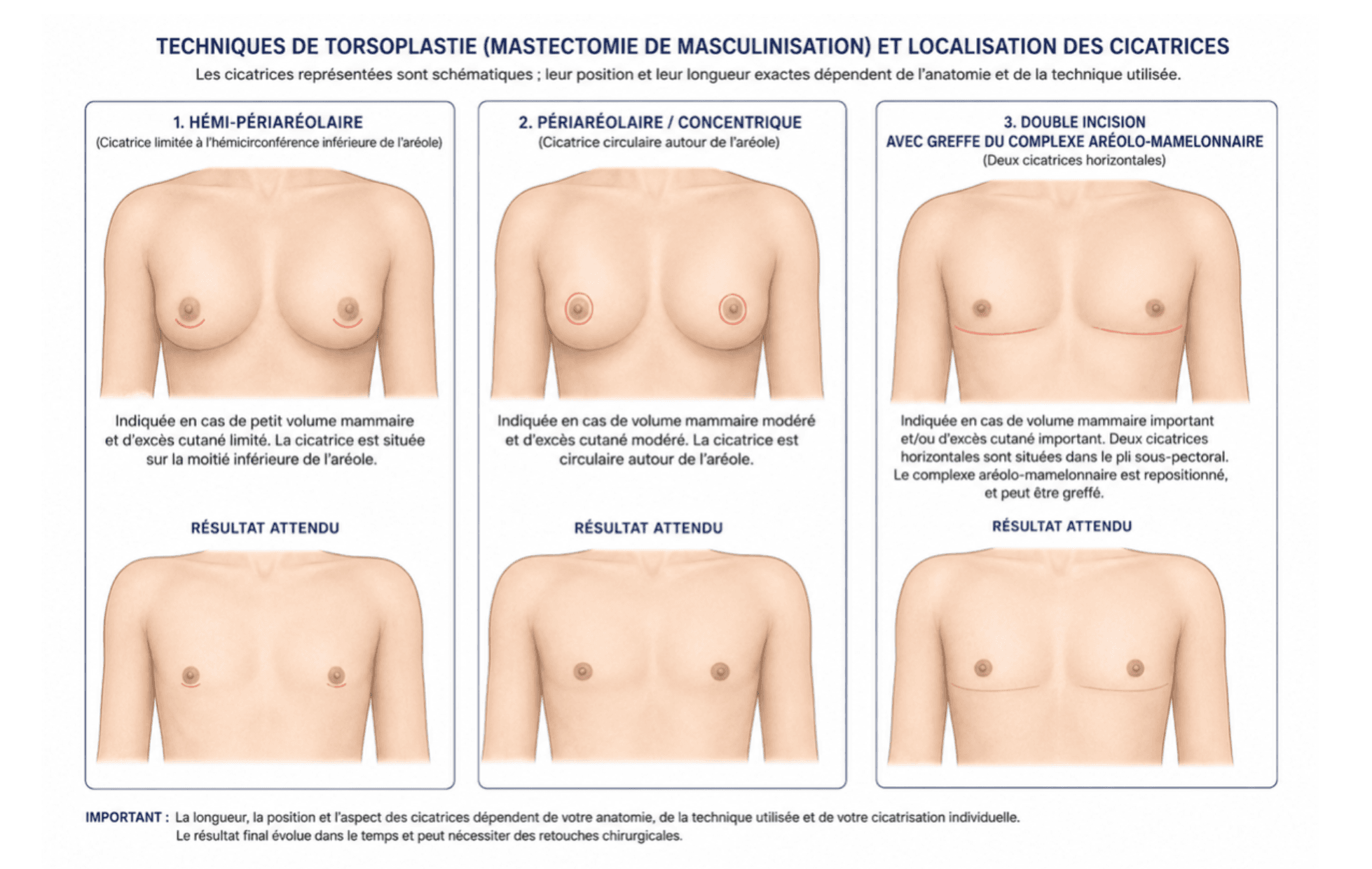
Dr Manon Belhoste performs four chest masculinisation techniques, which differ in scar length and in how the areola and nipple are handled: a scar limited to the outline of the areola, which stays in place, or two horizontal scars with a graft of the areola and nipple. The choice is made during consultation, depending on breast volume, sagging (ptosis), excess and elasticity of the skin, the size and position of the areolas, and the patient's priorities regarding scars, sensation and contour.
Hemi-periareolar
Removes breast tissue through an incision along the lower half of the outline of the areola. The areola and nipple stay in place.
Concentric periareolar
Removes breast tissue and excess skin through an incision all the way around the areola, which can be reduced in size. The areola and nipple stay in place.
Double incision
Removes breast tissue and excess skin through two horizontal incisions on the chest, placed in the shadow of the pectoral muscle. The areola and nipple are taken out and then grafted into their new position.
Non-flat Top Surgery
Non-flat, a masculine chest that keeps some contour: it changes the volume and shape of the chest.
The procedure and recovery
Dr Manon Belhoste performs this procedure in Marseille. A consultation with the anaesthetist takes place before the procedure.
| Parameter | Detail |
|---|---|
| Anaesthesia | General anaesthesia. |
| Duration | 2 to 3 hours, depending on the technique and anatomy. |
| Hospital stay | Same-day discharge, or one night in hospital depending on the situation. |
| Equipment | Drains: sometimes placed to drain blood and fluid for 1 or 2 days. - A compression garment on the chest for about 6 weeks. |
| Exercise and strenuous activity | Sport and heavy lifting are stopped for about 3 months. Return to work will depend on your job. |
| Changes over time | After this procedure, chest volume can change with weight, age, skin quality, hormone treatments and time. The final result is assessed after several months. |
Frequently asked questions
Here is a visual and schematic representation of chest masculinisation surgery.
Chest masculinisation surgery gives a lasting masculine chest by removing most of the breast tissue. Non-surgical options, such as compression garments or binding, change the appearance of the chest only temporarily. They do not permanently alter its anatomy, and they can cause lasting damage to the quality of the chest skin.
Before chest masculinisation surgery, Dr Manon Belhoste and the anaesthetist give instructions on fasting and medication, which must be followed. Stopping smoking and nicotine is required. All treatments and supplements must be declared, in particular anticoagulants, antiplatelet drugs, anti-inflammatories, hormone treatments, psychotropic medication, diabetes treatments and herbal remedies. No prescribed treatment should be stopped on its own, and how hormone treatment is managed around the procedure is decided case by case. Any personal or family history of breast or ovarian cancer and any known genetic mutation must be reported, as must any fever, cough, infection or skin problem. Arrangements for getting home and for the support you will need are made before the procedure.
After chest masculinisation surgery, pain, chest tightness, bruising and swelling are common in the first few days. Dr Manon Belhoste gives instructions on dressings, showering, scar care and sun exposure at discharge. Scars often remain red, firm and visible for the first few months, then gradually fade. Scars take 12 to 18 months to mature, sometimes longer.
Top surgery is a chest masculinisation mastectomy. It removes most of the breast tissue. Some glandular tissue may remain, unlike in a mastectomy for breast cancer. The tissue removed is sent to the laboratory for analysis.
Binding changes the appearance of the chest only while the garment is worn. The anatomy of the chest stays intact. Binding or taping is strongly discouraged if chest masculinisation surgery is planned, because it irreversibly alters the quality of the skin and can affect the future quality of the scar and the choice of surgical technique.
Whether sensation is kept depends on the surgical technique. With techniques whose incisions are in the areola, sensation is generally kept but may still be reduced. The chest, areola and nipple may be less sensitive. After a graft of the areola and nipple, erogenous sensation may be reduced or lost permanently.
The price of chest masculinisation surgery includes Dr Manon Belhoste's fees, follow-up consultations after the operation, anaesthesia and clinic fees.
Dr Manon Belhoste
Dr Manon Belhoste is a plastic surgeon, Doctor of Medicine and holder of the European Diploma in Plastic, Reconstructive and Aesthetic Surgery.
Dr Manon Belhoste's background
The practice
Dr Manon Belhoste holds consultations at her practice, 1 Boulevard Lord Duveen, 13008 Marseille, from Monday to Thursday.
Operations take place at the La Phocéanne polyclinic and the Phénicia clinic, in Marseille.
The practice and the clinicsPage updated on 10 October 2026.